Personalized Books for Kids: A Complete Guide
What makes a personalized book worth keeping, how to choose one for a child you love, and why the right book becomes a twenty-year keepsake instead of another thing on the shelf.
Published June 12, 2026 · LegendCraft Editorial
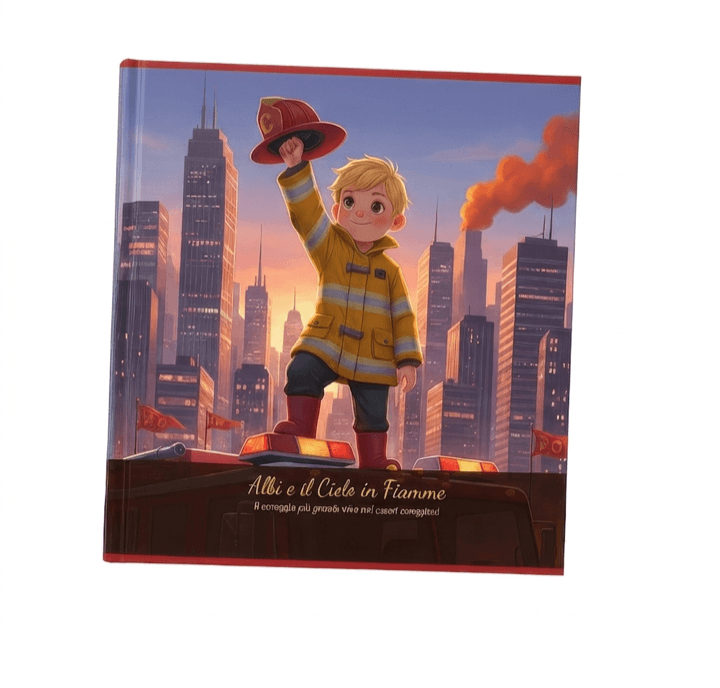
On the cover of the book, Alberto is a firefighter. He is saving New York. He is four — a real four-year-old whose face is on the cover, whose obsessions shaped what the story is about, whose name is genuinely his. The book was made for him. Only him. Printed once. Never again.
His father, Tommaso, wrote about it a few days later. The family had read it together — he and Alberto’s mother watched their son stay engaged the whole way through, the kind of engaged a child who recognises themselves in a story is. They are going to keep it, he wrote. A lovely keepsake they will treasure for years to come. By the last page, Alberto had one question. He wanted to know when volume two was coming out.
That is what a personalized book for a child is supposed to do. Not a name swapped onto a template. Not a cute face on a cardboard hero. A story that knows who the child is, and shows them being the version of themselves they are quietly trying to become.
This guide is for the parent, godparent, aunt, uncle, or grandparent who is thinking about buying one. We will cover what makes a personalized book actually personalized (most aren't), how to pick the right one, what ages it works best for, and what to look for when you want the book to do more than entertain — when you want it to be a small piece of how a child learns who they are.
Why does a personalized book actually matter for a child?
Between the ages of two and five, a child is doing the hardest cognitive work of their life. They are learning that the face in the mirror is theirs. They are learning that their name is a name and not just a sound. They are learning that they exist as a person separate from their parents — and this is genuinely strange to them. Most of their inner life is a wide, lit room they have not finished mapping yet.
Books are part of how they map it. A picture book is not just entertainment at that age. It is a model of what a person can look like, sound like, want, fear, do. Every story they hear is a small piece of the architecture they are building for themselves. This is why early-childhood educators talk about "mirrors and windows" — books should give children both: mirrors so they can see themselves, windows so they can see everyone else.
Most children's books give them windows. The hero is a brave rabbit, or a curious bear, or a little boy named Max in a wolf suit. The child empathises across the gap. That is good and necessary. But mirrors — actual mirrors, a hero who looks the way they look and lives in a body shaped the way their body is shaped — are scarce. For some children, depending on their hair, their skin, their abilities, the family structure they live inside, those mirrors are vanishingly rare on a bookshop's shelves.
A personalized book is a mirror written deliberately for one child. Not a generic story with their name printed on top, but a narrative shaped to who they actually are: their fear of the dark, their obsession with rocks, their new little brother who arrived last week and is, frankly, ruining everything. When done well, it does something other books cannot. It says: a story like the ones you love is also a story about you.
That sentence does quiet, foundational work in a young child. It is not magic. It is recognition. And recognition, in the years a person is figuring out who they are, is one of the most useful things you can hand them.
What's the difference between a name-only book and a truly personalized one?
Most "personalized" children's books on the market — and the category is now well over a decade old, with brands like Wonderbly leading it — change the cast and not the story. The child's name is swapped into a template adventure that was written for nobody in particular. Their hair color might match. The plot does not. A book written for a generic three-year-old is then sold to a million specific three-year-olds, with the assumption that the name on the cover is enough.
For a lot of children, it is enough. Seeing your name in a printed book is a thrill at four. We are not here to tell you a name-only book is worthless — it isn't. But there is a real difference between the version of the format that swaps the cast and the version that rewrites the story.
A truly personalized book changes three things, not one. First, the cast — the protagonist looks like the child, including hair, skin, eyes, accessories, the things a child wears or carries that have become part of who they feel they are. Second, the world — the setting reflects something the child cares about: pirates if they are obsessed with pirates, space if they are obsessed with space, a fairy-tale forest if they have been narrating their afternoons as a princess for six months. Third, and most important, the story arc — the emotional spine of the book is shaped to a real trait or fear the child is working through right now.
That third change is the one almost no one in the category actually does. It is also the one that makes the book worth keeping. A book that knows your child is mildly terrified of large dogs and writes a chapter where that exact child walks up to a friendly dog and learns its name is doing something a template cannot do. The story is doing work in the child's life, not just decorating it.
This is the line we draw, and it is the line that separates the gift you remember from the gift that ends up in the donation pile next Christmas. Personalized has to mean more than your name on the cover. It has to mean the book was written for you.
What should a great personalized children's book actually include?
Three things, in equal weight. Skip any one and the book is missing the leg of the stool that makes it worth keeping.
The first is live-alike. The story has to be about who the child actually is. Their humor. Their obsessions. The fear they keep coming back to. The small, specific things their parents recognise instantly and a stranger would not. A four-year-old who collects pebbles and keeps them in a coat pocket should find a hero in their book who collects something the same way. A child who has just stopped using a pacifier and is proud of it should have a story that quietly honors that win. The personalization is in the narrative spine, not the cast.
The second is look-alike. The child on the page has to actually look like the child reading. Their hair, their skin, their eyes, their gait, the glasses they wear, the hearing aids, the chair they sit in if they sit in one. Recognition has to happen on the first page or the whole project is dead. This is the part most of the category gets roughly right today — though "roughly" is doing a lot of work in that sentence. We have all seen the personalized books where the cartoon kid looks like the cousin of the kid in the photograph. That is not look-alike. Look-alike is the child seeing themselves and saying, without prompting, "that's me."
The third is craft as artifact. The book has to be made well enough to deserve its place on a shelf for twenty years. Hardcover. Heavyweight paper that feels good between small fingers. Binding that survives a thousand openings. Print quality where the illustrator's intention comes through and the color does not flatten out by page six. This is the part most personalized-book brands either skip entirely or treat as a premium add-on. We treat it as the floor.
The triad is not three features you can pick from. It is one thing. A book that is live-alike and look-alike but printed like a flyer is something you flip through and recycle. A book that is beautifully bound but feels like it was written for anyone is a coffee-table object, not a piece of a childhood. A book that has all three is the kind a parent keeps in a drawer after the child has outgrown it and still cannot bring themselves to give away.
What kinds of personalization are actually possible today?
More than parents usually realise, and less than the marketing of some platforms implies. Here is the honest shape of what a modern personalized book can do, and where the limits still are.
On the look-alike side, you can specify with real precision: name, gender, body type, skin tone, ethnicity, hair color, hair type (straight, wavy, curly, coily, bald), the style the hair is worn in, eye color, and any accessory the child lives with day-to-day — glasses, hearing aids, a brace, a favorite hat, a soft toy they refuse to be parted from. A book that picks up all of those features will produce a protagonist a child recognizes the first time. A book that only picks up name and hair color produces a protagonist a child squints at.
On the live-alike side — the harder side — you can specify the world the child wants to live in (pirates, space, fairy-tale kingdoms, dinosaurs, ocean depths, ordinary neighborhood with a twist), the protagonist type (the explorer, the inventor, the brave one, the kind one), and what we call traits: up to two things that make the child who they are right now, and up to two things they are working on growing into. That last category is where the magic happens. A child who is shy and is working on speaking up at preschool can have a story shaped around exactly that arc. A child who is afraid of thunderstorms can have a story where the protagonist sits with a storm and discovers it has a name.
A reasonable question to ask here is: how is this possible at a per-book price that does not buy you a custom commission from an illustrator? The honest answer is that the technology has improved enough that a thoughtful product team can use it to do the work a thoughtful product team should always do — attend to one specific child instead of writing one story for a million children. We do not lead with "AI-generated" because that phrasing implies the artistry got skipped. It did not. The technology is a tool that lets craft scale to a single reader. The story is still a story. The illustration is still an illustration. The decisions about what should be in this child's book are still decisions a person makes, using the tools available.
What is not yet possible — fairly — is a book that captures inside jokes, family vocabulary, the name of the dog, the name of the baby brother, all the small wrinkles of a specific household. We are working on more of this. For now, the format does the big things well: the hero is the child, the story is shaped around them, the printed object is built to last.
How do you choose a personalized book for a child you love?
If you are the parent, you already have most of what you need. You know your child. You know what they are currently obsessed with. You know what they are quietly afraid of. You know which book they ask for at bedtime, and which one they shove off the side of the bed when they want a different one. Use that.
If you are an aunt, uncle, grandparent, godparent, or family friend, this is harder. You do not see the kid every day. You are not sure what is currently obsessing them or scaring them. Here is the move: ask the parent one specific question, not three vague ones. Not "what is she into?" — you will get a list. Ask: "if I were going to write her a story right now, what would the story be about?" Parents answer that question instantly. They have been narrating their child's life inside their own head for months. You will get back something like "she's just stopped using her pacifier and she is so proud" or "she wants to be a veterinarian this week" or "we have a new baby coming and she is acting out." That is the answer you build a book from.
When you go to build a book around your child's specific traits, the things you want to weight heavily are: the world the child is currently inhabiting in their imagination, the single most distinctive trait they have right now, and the single most important thing they are working on growing through. If you only get those three right, the book will land. Get the small details right too — the hair, the glasses, the accessory they refuse to take off — and you will hand the child a book they recognise as theirs from the first page.
One more thing on choosing: the gift purpose matters. A book intended as a birthday or Christmas keepsake should lean keepsake — hardcover, gift-quality, a story built to survive a hundred re-readings. A book intended to help a child through a specific transition (starting school, new sibling, fear of dogs) should lean situational — the story arc should be the transition. Both are valid uses. The first lasts longer; the second works harder.
What ages are personalized books actually best for?
Two to five years old. There are personalized books that work for older children, and there are parents who buy them for babies as a birth gift, and both of those are fine. But the developmental sweet spot — the window where the format does the most work — is the early picture-book years.
At two, a child is doing the very first identity work. They are learning that the face in the mirror is theirs and not another baby's. They are starting to say "me." A book where every page contains a kid who looks like them, with their name on the cover, is a recognition exercise that supports exactly the cognitive work they are already doing. They might not "read" the story yet. They will study the pages.
At three and four, a child is in the imaginative-play period. They narrate everything. They are a fireman in the morning and a princess after lunch. A personalized book gives that narration a settled, repeatable form. It says: here is the version of you the story chose to write down. Read at this age, the book gets internalized. Months later, in a moment unrelated, the child will refer to themselves in terms borrowed from the book's protagonist. They are doing the same thing they do with characters from books and films they love — except this character is them.
At five, a child is starting to read for themselves. A personalized book becomes one of the books they most want to read independently, because the protagonist is them, and figuring out the next word is figuring out what they did next. Books at this age that the child wants to read are worth far more than books they are willing to read. The personalization does heavy lifting on motivation.
After five, the format still works, but the marginal value drops. By seven or eight, children are building their own identity outside the home in ways that a parent-curated story cannot fully reflect. The book becomes a memory object more than a development tool. Still nice. Less load-bearing.
LegendCraft's books are specifically designed for ages two through five — short text, illustration-led pages, story arcs calibrated to what a child of that age is actually wrestling with. That focus is deliberate. We would rather make one book that does the most for the years that need it most than spread thinly across every age.
Can a personalized book help a child face a fear, a transition, or a big feeling?
Yes. This is where the format does its best work and where the difference between a name-only book and a real one shows up sharpest. A few specific cases we hear about often:
A child afraid of the dark. The book gives the child a version of themselves who walks through the dark and meets something on the other side that is small and curious and not scary. After enough re-readings, the story sits in the child's head as a script. When the dark room arrives in real life, the script comes with them. We hear from parents whose children, after a month of bedtimes with a book like this, started narrating themselves through the hallway: "and then she walked past the door, and she wasn't even scared."
A child starting preschool or kindergarten. The book stages the first day before it happens. The protagonist walks into a building they have never been in before. Meets a teacher. Eats lunch with kids whose names they don't know yet. Comes home. This is rehearsal. A child who has rehearsed the first day in a story they love walks in less afraid.
A child getting a new sibling. The biggest emotional event of an early childhood. The book can make the older child the protagonist of the family change — the one who notices, who adapts, who teaches the baby a few things. This reframes a transition that is otherwise experienced as loss. We have heard from a parent whose three-year-old started introducing her newborn brother to visitors using phrases lifted directly from the book.
A shy child. The book gives them a protagonist who is also quiet and watchful — and gradually, in the arc of the story, finds a moment to use their voice. Not a transformation into someone different. A widening of what is possible inside who they already are.
A child afraid of dogs, or thunderstorms, or strangers, or the doctor, or any of the dozen small fears that are large to a four-year-old. The format handles them well because it can hold the fear inside the story and let the child watch themselves move through it from a safe distance. This is the same mechanism therapists use with structured play. The book is a soft, repeatable version of it.
None of this is therapy. We are careful with that word. A book is a book, not a clinical intervention. If a child is struggling, a clinician is the right call. But for the everyday fears and transitions that fill an early childhood, a story shaped around the child is one of the gentlest tools a parent has.
How long do these books actually last as keepsakes?
If they are made well, decades. We mean that literally. A hardcover children's book bound on quality paper with proper print will survive a thousand bedtime readings and still close flat. That is the bar. Anything below that bar is a paperback you are pretending is a gift.
There is a category of object — and most adults can name two or three from their own childhood — that survives houses, moves, redecorations, the wave of toys donated to charity at age seven. Those objects are not the toys. The toys go. What survives are the books that meant something and the pieces of art that captured a specific moment in being four. A personalized book made to keepsake-grade belongs in that category. It is built to be the book that makes it onto the shelf in the kid's adult apartment, twenty years from now, when they have moved out and started their own life.
The craft details matter. Hardcover binding — not paperback, not "premium softcover," hardcover. Glossy or matte laminated cover that will not scuff in a year. Interior paper heavy enough that a four-year-old turning pages quickly does not crease them. Full-color print where the illustrator's blacks are actually black and the warm colors are not pink. Square format, the kind a small child can hold open on their lap. A spine the kid can read.
This is also what justifies the price. A keepsake-grade personalized hardcover costs more than the paperback children's book on the bargain shelf at the supermarket. It should. It does a different job. A bargain paperback is bought for a single afternoon. A keepsake book is bought for a childhood — and then, if it was made well, for the shelf the adult version of that child keeps it on.
If the craft argument matters to you when you are choosing, the format, paper stock, and print specifications are spelled out here. The €29.99 price holds the line where a real gift book should sit without making the artifact feel disposable.
What makes LegendCraft's personalized children's books different?
We make one book and we make it well. The book is a twenty-one-page hardcover, printed on Crown Quarto stock, full color, illustrated and bound to be the book that makes it onto the shelf in the adult version of the kid's apartment, twenty years from now.
What we focus on, in order:
The story is shaped around who the child is, not the cast. You tell us the world the child is currently inhabiting in their imagination — pirates, space, fairy-tale, dinosaurs, ordinary-life-with-a-twist — and up to two traits that make them who they are right now, and up to two things they are working on growing through. We build the narrative arc from there. The child is not a name printed onto a template. The story is theirs.
The illustrations look like the child. You tell us hair color, hair type, hair style, skin tone, ethnicity, eye color, body type, gender, any accessories that have become part of who they feel they are. The protagonist on the cover is the kid holding the book. When you make a second book for the same child, we reuse their avatar so the look stays consistent across books — they grow up alongside the same drawn version of themselves.
The book is printed and bound to be a keepsake. Hardcover. Heavyweight paper. Full color throughout. Made at a real print house, not run off a desk. €29.99, with €6 flat shipping anywhere in the EU. Available in English, Italian, Spanish, and French — the story is rewritten natively per language, not machine-translated.
You can build the book in about five minutes — you'll see the full digital preview before you decide whether to print. If the preview does not feel like the right book for your kid, you do not have to order. Most parents do. The printed copy ships in seven to fourteen business days.
We are doing the kind of thing the category was supposed to do all along: a real book, shaped for a real child, made to be kept.
Frequently asked questions about personalized books for kids
- What age are personalized books for kids best for?
- Two to five years old is the sweet spot. That's the window when a child is doing the hardest cognitive work of their life — figuring out who they are. A book that hands them a coherent version of themselves to recognize, return to, and rehearse becomes a tool for that work. Older children love them too, but the developmental impact is highest in those early years.
- What's the difference between a personalized book and a name-only book?
- A name-only book swaps the protagonist's name and maybe a hair color into a template story written for nobody in particular. A truly personalized book is written around your child — their fears, their humor, the way they move through the world. The story itself changes, not just the cast. That's the line we draw, and it's the line that makes the book worth keeping.
- How long does it take to make a personalized book?
- You'll see a digital preview within three to five minutes — the full character, the full story arc, every illustration laid out as your child will see them. Once you order the printed edition, it's shipped within seven to fourteen business days. The book itself, of course, is meant to last twenty years.
- Can a personalized book help a child who is afraid of the dark, or starting school, or getting a new sibling?
- Yes — and this is where the format does its best work. When a four-year-old sees a kid who looks like them, named like them, walk into the dark room and come out the other side, they're not just hearing a story about courage. They're rehearsing it. We've heard from parents whose kids asked to hear the book every night for a month before a transition — preschool, a new sibling, a move. The book becomes a script for what's coming.
- Is a personalized hardcover book a good gift from an aunt, uncle, or grandparent?
- It's one of the best gifts in the category. Most relatives default to clothes that don't fit by Christmas or another toy in the pile. A personalized hardcover book is unmistakably for that specific child — their name on the cover, their face in the illustrations, traits the family will recognize. It sits on the shelf for years. It gets read at bedtime. It does the job a gift is supposed to do.
- How much does a LegendCraft personalized book cost?
- €29.99 plus €6 flat shipping anywhere in the EU. We don't pad the price for a velvet box or a tassel bookmark. We put the money into the paper, the binding, and the time it takes to design a real story instead of a template — and the price holds the line where a gift book belongs without making the craft feel disposable.
- What if my child has a feature that most books leave out — curly hair, a wheelchair, glasses?
- Then this is what the format was built for. The personalization picks up hair color and type (including curly, coily, and bald), skin tone, ethnicity, eye color, and any accessory you want included — glasses, hearing aids, a favorite hat. Every child who sees their book should recognize themselves on the first page. Not someone close-enough. Themselves.
- Are personalized books a good first book to read with a two-year-old?
- They're an exceptional first book. At two, a child is just starting to recognize their own face in mirrors and photographs. A book where every page contains that face turns reading into a game of recognition before it becomes a game of language. The pages are designed for short attention spans — illustration-led, with short text — so the child can drive the pace.
If you have a question that isn't answered here, the full support FAQ is at /faq — or you can email hello@legendcraft.io.
Ready to make a book for the kid you love?
Five minutes to a full preview. €29.99 if you decide to print. A book made to stay on a shelf for twenty years.
Or read more on the LegendCraft homepage.